The Exposure Triangle: A Primer
There is much to be said, in photography, about exposure. In fact, few things are more important in photography than exposure. But what, exactly, is it? Simply put, exposure refers to the amount of light entering the camera. This is controlled in 3 ways.
First, we have the aperture. The aperture value measures the size of the optical opening of the lens, and it is analogous to the pupil of the eye. Just as the pupil can constrict and dilate to control the amount of light that enters, the aperture value controls the constriction and dilation of the diaphragm, which is, essentially, the camera’s pupil. It is measured in “f-stops”, which form a scale, conventionally, from 1.2 to 22 (although in more specialized cameras, we may find f-stops lower than 1.2 and greater than 22.)
Second, we have the shutter speed. The shutter is the mechanical curtain that covers the sensor of a digital camera. When taking a photo, the shutter momentarily opens, exposing the sensor to light. It is measured in seconds and minutes.
Third, we have the ISO. The ISO isn’t a mechanical component of the camera, per se, but is, instead, a parameter that controls the sensitivity of the sensor to light.
Collectively, these form the exposure triangle.
If you wish to move beyond the confines of the Automatic Shooting Mode, understanding the components of the exposure triangle, and their interactions, is vital.
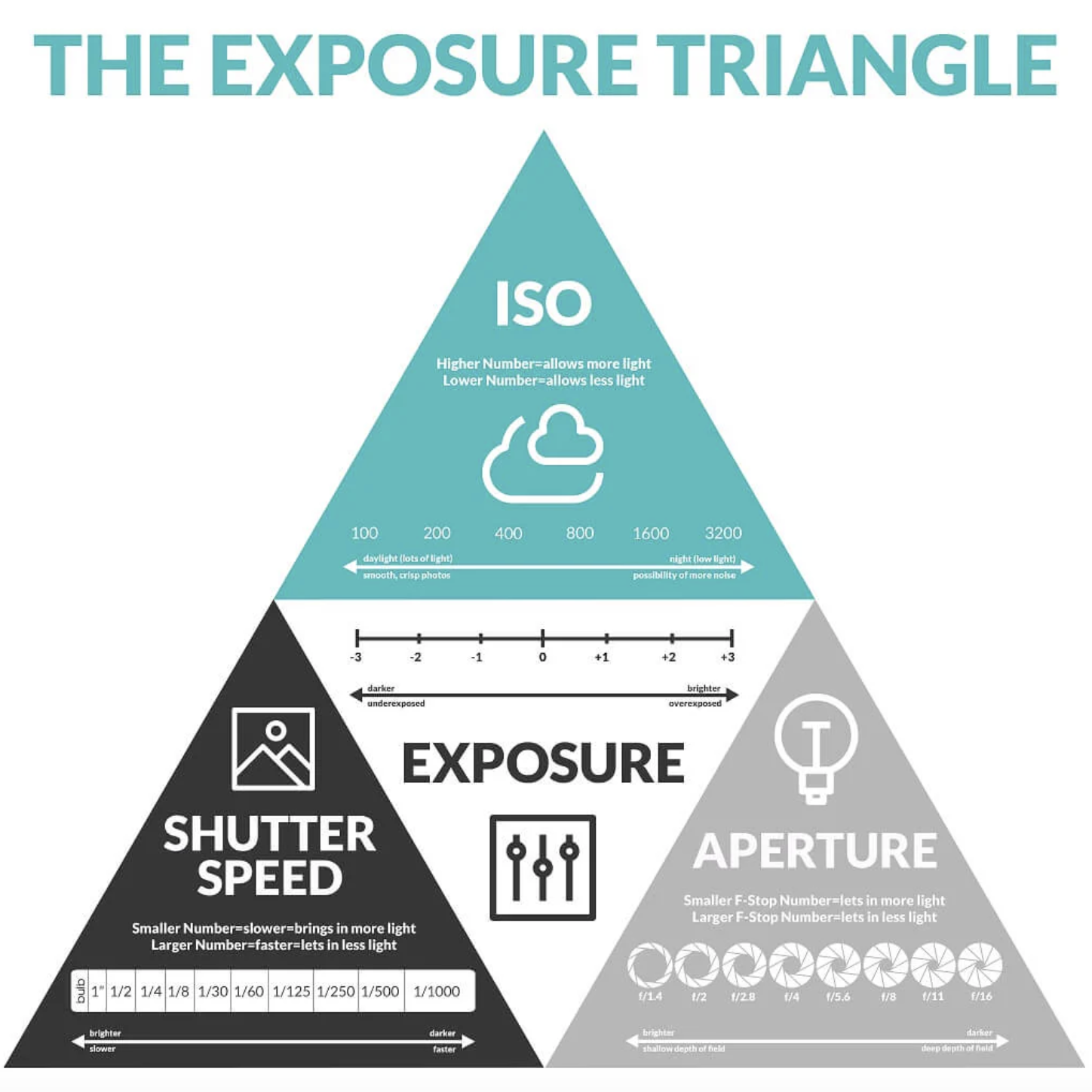
Credit to Pretty Presets for the graphic.